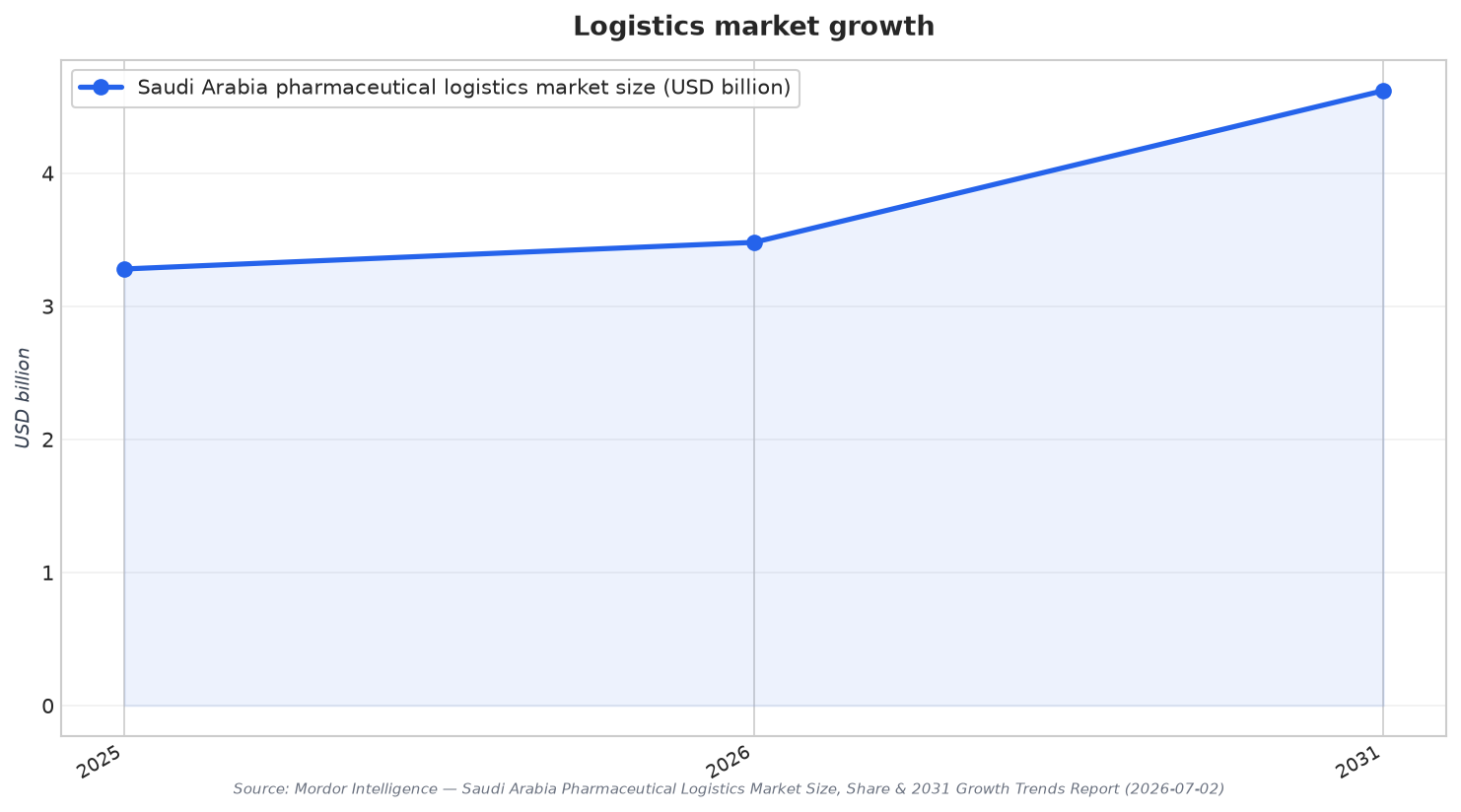
Saudi Arabia pharmaceutical distribution is being stress-tested as supply chains re-route and dwell times become less predictable. The country remains the largest pharmaceutical market in the GCC and still relies on imports for 70% to 80% of its pharmaceutical supply, which keeps national logistics capacity central to availability across hospitals, pharmacies, and public procurement channels. Market outlooks underline why partner choice matters. Future Market Insights sizes the Saudi Arabia pharmaceutical market at USD 11.7 Bn in 2026 and forecasts USD 22.9 Bn by 2036, at a 6.3% CAGR from 2026 to 2036. In parallel, Mordor Intelligence values the Saudi Arabia pharmaceutical logistics market at USD 3.28 billion in 2025, rising to USD 3.48 billion in 2026 and USD 4.62 billion by 2031, at a 5.84% CAGR (2026–2031).
When routes change, transportation becomes the most immediate risk surface. Mordor Intelligence reports transportation held 62.78% of pharmaceutical logistics market share in 2025, showing how exposed service levels can be to constraints at ports, air routes, or domestic linehaul. At the same time, value-added services are projected to expand at an 8.67% CAGR through 2031, reflecting rising emphasis on serialization support and temperature deviation reporting. For partner selection, this shifts the due diligence checklist toward execution detail: the ability to clear, move, and replenish under variability; the presence of digitally enabled import handling; and practical capabilities for higher SKU counts and more frequent replenishment cycles as healthcare delivery points widen.
What to Audit in Distribution Partners When Routes Re-route
Cold chain is a key fault line as biologics adoption broadens and enforcement tightens. Mordor Intelligence projects cold-chain logistics growth at a 7.84% CAGR through 2031, while non-cold-chain represented 59.97% of market size in 2025. BioNixus notes that large agents either use validated in-house cold rooms or subcontract to GDP-certified 3PLs such as DHL Supply Chain and Almajdouie, while smaller agents typically rely entirely on 3PL partners for temperature-controlled lanes. That reality makes cold-chain readiness audits practical, especially for biologics launches, including validated storage, reefer capacity, and last-mile handling. The strongest partners will show traceable processes for deviations and proof of GDP-aligned operations rather than marketing claims.
Compliance structure also shapes who can act as a commercial bridge when global routing becomes constrained. BioNixus states imported medicines must be registered with the SFDA by a licensed Saudi establishment that acts as the marketing authorisation holder and importer. Foreign companies may open a scientific office to promote products, but the commercial and regulatory chain runs through an appointed Saudi agent or distributor. This makes partner choice strategic, not tactical. It determines who controls registration, import continuity, and the handoffs into hospital and retail channels. Future Market Insights highlights that hospital pharmacies hold the leading channel position due to strong institutional dispensing across regulated therapy use, which raises the premium on partners with dependable access to supervised care settings.
Finally, the best-fit model depends on product risk and replenishment consequences. A Saudi Pharmaceutical Journal study summarized in Saudi Market Research Consulting describes sterile injectable products as a critical class that frequently faces shortages and can compromise patient care, linking shortages to supply chain disruptions and noting domestic manufacturing remains limited. That combination argues for partners that support advanced forecasting, risk-based inventory management, and resilient replenishment options. It also aligns with Vision 2030 themes cited by IMARC, including strengthening local manufacturing and improving supply security, alongside system changes such as digital prescription systems and insurance integration that can lift retail utilization. In practice, choosing distributors and 3PLs with multimodal integration, in-country footprints in hubs such as Riyadh, Jeddah, and Dammam, and mature compliance services can reduce avoidable loss during stressed trade conditions.
What is changing in Saudi Arabia’s pharmaceutical distribution as shipping routes tighten?
How large is the pharmaceutical logistics market in Saudi Arabia, according to Mordor Intelligence?
Which logistics functions and services matter most when disruptions hit?
How should companies evaluate cold-chain partners for biologics in Saudi Arabia?
How does SFDA registration affect Saudi Arabia pharmaceutical distribution partner selection?