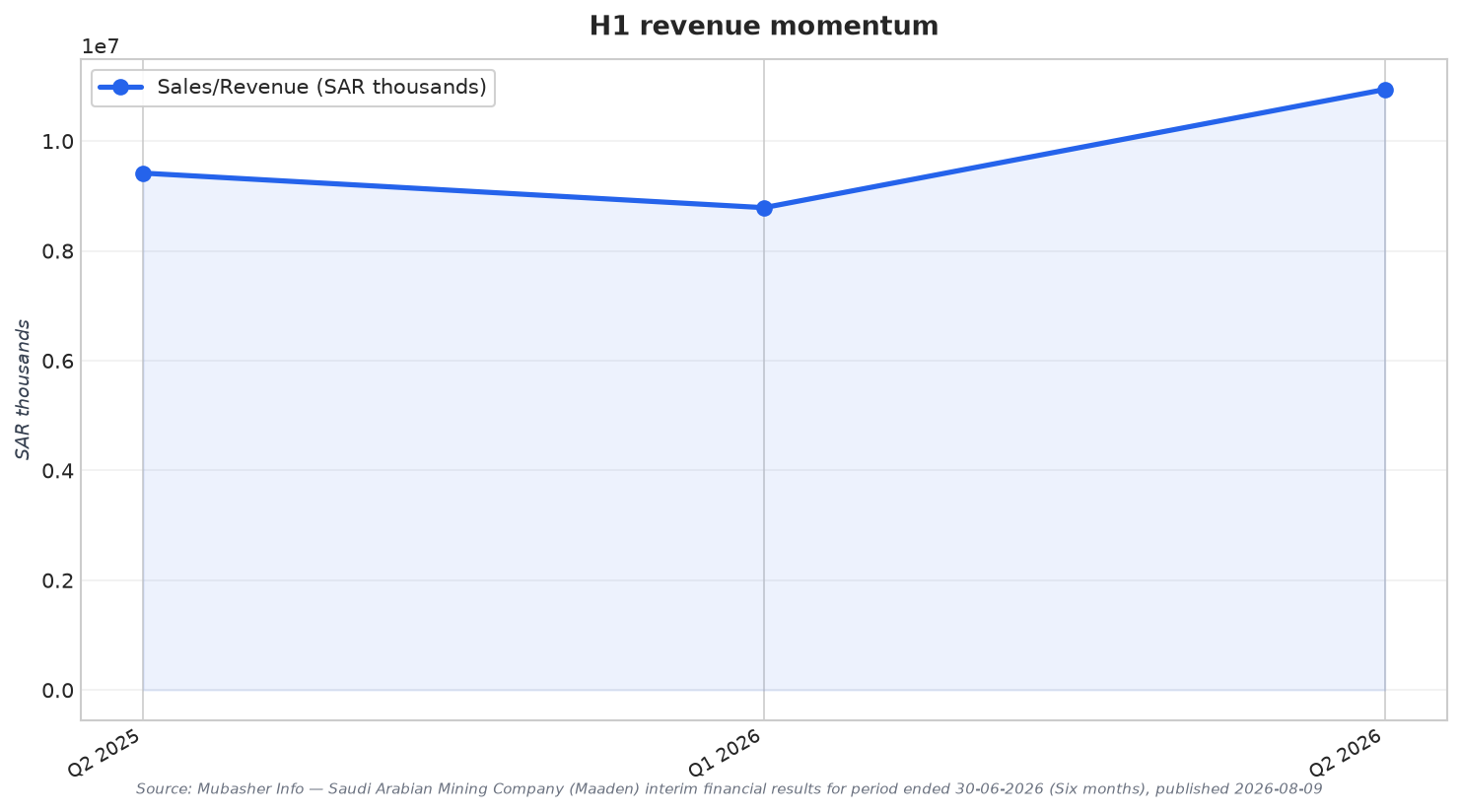
Ma’aden’s interim reporting for the period ended 30-06-2026 put real numbers behind the “commodity windfall” narrative, while also showing why headline growth can be misleading. In second quarter 2026, sales/revenue were 10,939,233 (presented in thousands of Saudi Riyals), up from 9,415,768 in the similar quarter of the previous year, a 16.179% increase, and up from 8,786,554 in the previous quarter, a 24.499% increase. Over the same quarter, gross profit (loss) was 3,388,614 versus 3,523,314 a year earlier, down 3.823%, but up 8.434% from 3,125,031 in the previous quarter. For investors, that mix—rising revenue with softer year-on-year gross profit—frames the core question: where is the earnings quality coming from, and how repeatable is it?
External analysis of the same quarter points to uneven earnings momentum across divisions. Ma’aden posted Q2 2026 revenue of about US$2.9 billion, up 16% year on year, while group EBITDA rose only 3% to US$1.0 billion. Gold was the standout in profitability terms: gold EBITDA jumped 46% to US$334 million on production of 118,000 ounces. Phosphates moved in the opposite direction, with phosphate EBITDA falling 49% to US$328 million after sulphur shortages cut DAP output by 28%. That split matters for Saudi mining earnings because it suggests the strongest contributor in H1 was not necessarily the largest volume business, but the one with better pricing and/or operating conditions in the period.
What H1 2026 Reveals About Guidance, Costs, and Cash Flow Risk
Management actions and guidance changes are the other half of the H1 message. Following the operational disruption in phosphates, Ma’aden cut 2026 DAP guidance to 6.0-6.5 million tonnes and withdrew ammonia guidance, while leaving aluminium and gold guidance unchanged. The Saudi Exchange announcement also noted that profitability was supported by higher other operating income in the phosphate business unit due to one-off insurance proceeds of SAR 375 million, plus lower finance cost and a higher share of net profit from equity-accounted investments. It added that the increased share of profit was mainly attributable to higher share of profit from Alba and Maaden Barrick Copper Company, partially offset by a one-off impairment recognized by Manara for its investment in Vale. Investors weighing underlying earnings strength will likely separate these one-offs from run-rate operating performance.
Earlier in the year, the first-quarter base established a slower growth starting point. A 1Q26 result review reported revenue of SAR 8.8bn, up 3% year on year, and another report described that same quarter’s revenues as ر.س8.8b, 11% below analyst expectations, with a per-share statutory loss of ر.س1.91. After those results, a seven-analyst consensus forecast referenced revenues of ر.س47.1b in 2026, and before the earnings report the same group had been forecasting revenues of ر.س40.6b. Whether those model upgrades prove durable will depend on the same factors H1 exposed: sulphur availability, DAP output stability, and the balance between stronger segments like gold and weaker quarters in phosphates.
Finally, H1 2026 is also about capital intensity and ownership structure. Ma’aden guided 2026 capex of about SAR 15.5 billion, including roughly SAR 12.6 billion of growth spending. That spending is expected to lift Fitch’s EBITDA net leverage measure from 1.9x in 2024 to about 3.1-3.2x in 2027-28. Control also matters for investor expectations: PIF held approximately 63.78% of Ma’aden as of 31 December 2025, an anchor for Fitch’s BBB+ stable rating. Put together, the Maaden revenue 2026 story in H1 is not just about top-line growth, but about how commodity mix, guidance changes, and capex-funded expansion can reshape margins and cash generation across cycles.
What did Ma’aden report for Q2 2026 revenue growth?
Which divisions drove the biggest EBITDA moves in H1 2026?
How did guidance change after H1 2026 developments?
What should investors watch when analyzing Ma’aden revenue in 2026?
How large is Ma’aden’s planned 2026 capex, and what does it imply for leverage?