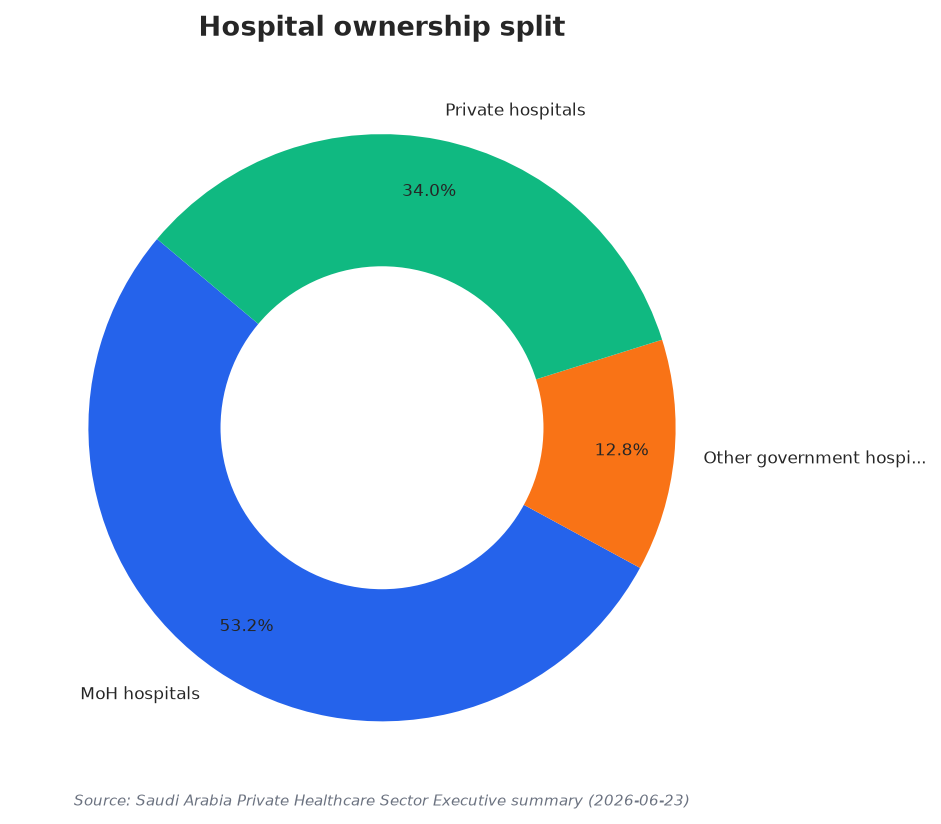
Saudi Arabia’s hospital base shows a mixed public-private structure that sets the context for competition among Saudi Arabia private hospital groups. As of 2024, the country had 516 hospitals: 290 under the Ministry of Health (MoH), 60 run by other government entities, and 166 in the private sector. Bed capacity was similarly segmented, with 57% provided by the MoH and 18% by other government entities. A separate 2023 snapshot reported 499 hospitals and 80,072 beds, including 150 private hospitals, and noted that government providers controlled about 77% of hospital beds in 2023. Together, these figures underline why private expansion is a strategic focus, while still operating in a system where the public sector remains the largest anchor.
Demand and policy shifts are pushing listed operators to add beds, but the buildout can pressure profitability. One sector view states that seven listed healthcare companies plan to add over 5,400 beds by 2028, described as an 81% jump in capacity, alongside a stated target of 19% annual profit growth. Another report forecasts that expansions by incumbent hospital chains could expand revenues of covered companies from SAR 31.4bn in FY25 to SAR 51.8bn by FY30e, implying a 10.5% CAGR, while cautioning that most capex is likely to be incurred over FY26–28e and margins may be impacted in the near to medium term. This combination—capacity acceleration and capex intensity—frames why investors watch ramp-up execution and utilization closely.
Margins and Utilization: What the Reported Numbers Reveal
Company-level disclosures show how fast growth can dilute near-term margins. One operator reported FY25 revenue of SAR 13.7bn, up 22.4% year over year, with growth described as predominantly capacity-led. In the same set of sector notes, that operator’s occupancy was said to have declined to 60% from 80% in FY23 following six new hospital launches, with margin recovery expected from FY27. In contrast, Mouwasat was highlighted for profitability, with a five-year average gross margin of 46% and a sector-best free cash flow to firm (FCFF) margin of 15%, and it was described as self-funding expansion through internal cash flows. These metrics illustrate the range between rapid buildout with utilization digestion and a cash-generative expansion model.
Expansion pipelines also differ in specificity and pace. One report stated that a major operator added 975 beds in FY24 and 580 beds in FY25, completing around 72% of its planned capacities through FY23–FY30e. The next phase of expansion cited includes hospitals with 140 beds in Tabuk (by FY27e end) and 145 beds in Jubail. Sector commentary also notes that mid-tier operators such as AlHammadi and Specialized Medical Company (SMC) may feel structurally compelled to keep expanding to defend market share against leaders, and that higher bed density in a concentrated market can raise execution risk and increase margin sensitivity, especially for single-region operators. A separate example points to inorganic growth pressure, referencing Fakeeh’s acquisition of a 180-bed hospital in Riyadh.
Scale, geography, and payor mix can shape operating outcomes. An industry snapshot describes Dr. Sulaiman Al Habib Medical Group as the largest by revenue and market value, with more than 20 hospitals and medical centres across Riyadh, Jeddah, the Eastern Province, and Dubai. It also characterizes Mouwasat as dominant in the Eastern Province and Jubail, while Dallah is presented as a Riyadh anchor with new capacity in Namar and Al Kharj, and Fakeeh Care Group and Saudi German Health are described as Jeddah-rooted groups with national expansion. On earnings sensitivity, one market report states that insurance represented 52% of Saudi German Health revenue in Q1 2025, illustrating exposure to network inclusion, authorization, and reimbursement terms. At the policy level, one sector summary suggests DRG could be neutral-to-positive for large, well-run groups with strong coding and throughput, while being negative for smaller or less efficient providers.
How many hospitals were in Saudi Arabia, and what share were private?
What do the sources say about bed capacity control between public and private providers?
What expansion scale is cited for listed operators in Saudi healthcare?
Which profitability metrics are reported for Mouwasat?
What is one reported utilization and margin signal for major Saudi Arabia private hospital groups?