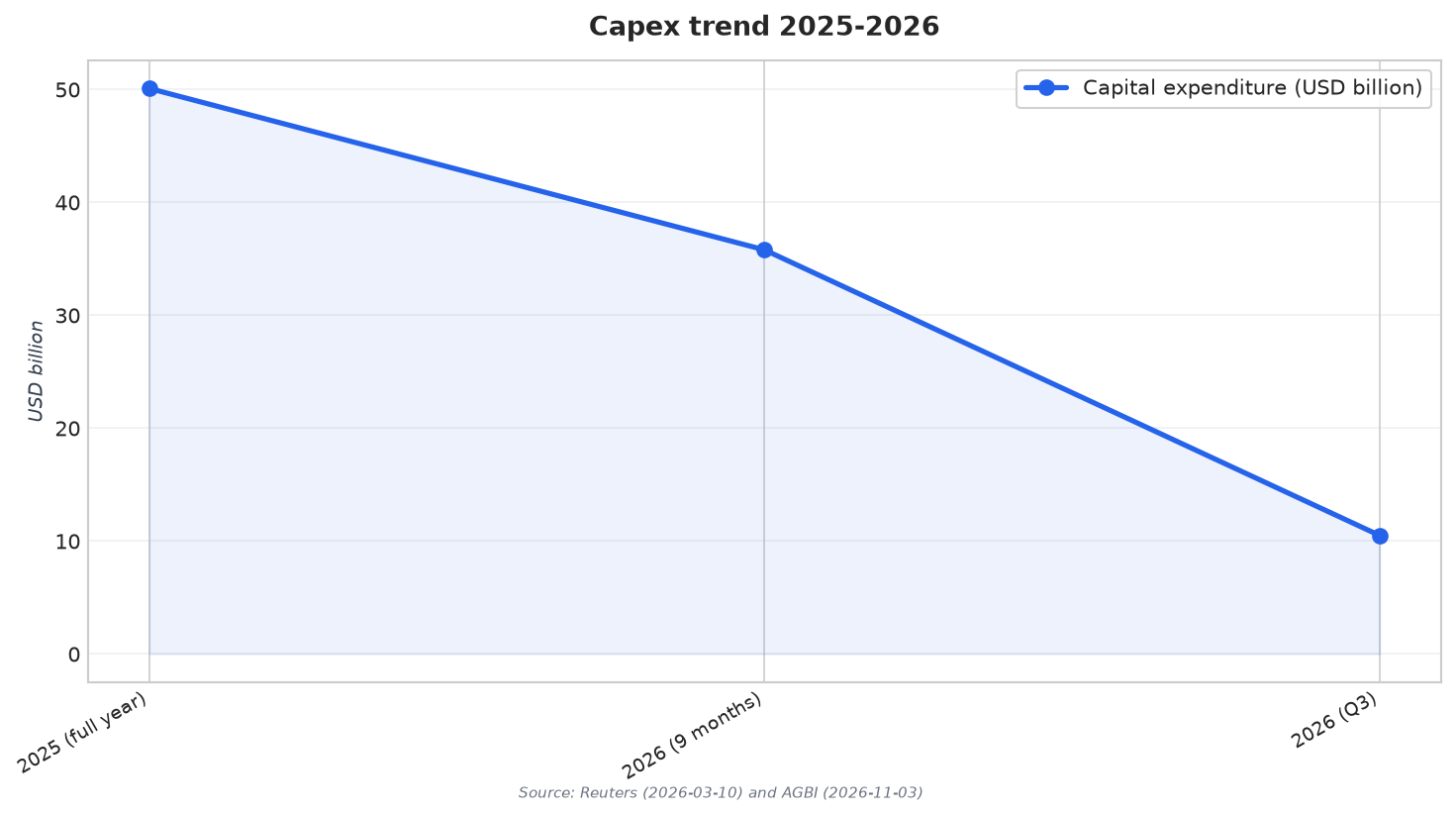
For suppliers and service providers, Aramco’s 2026 capital spending guidance is not just a corporate number. It is a demand signal that affects award timing, localization planning, inventory decisions, and workforce utilization. Reuters reported that Aramco guided for 2026 capital expenditures in the range of USD 50 billion to USD 55 billion, after capital expenditure of USD 50.1 billion for the year. AGBI also stated that Aramco maintained its 2026 guidance at USD 50 billion to USD 55 billion, and noted it includes restoration costs and investment in Humain, Saudi Arabia’s main artificial intelligence initiative. The practical takeaway for vendors is to plan for a large, but controlled, spend envelope where schedule, execution readiness, and measurable performance will matter.
Quarterly and year-to-date spending patterns add detail to that envelope. AGBI reported that capex fell 16% year on year to USD 10.5 billion in the third quarter of 2026, while capex fell to USD 35.8 billion in the first nine months of 2026 from USD 37.4 billion a year earlier. In the same report, revenue rose 26% to USD 140.5 billion and net profit climbed 35% to USD 36.3 billion, partly boosted by an asset sale. For suppliers, this combination can mean tighter sequencing and more scrutiny on execution, even when headline financials look stronger. It also suggests procurement teams may favor packaged scopes, proven contractors, and fast-mobilizing service models aligned with “priority projects,” as Aramco’s CEO described the focus.
Project Signals: Upstream Additions, Gas Momentum, and Digital Value
On the demand side, Reuters via TradingView/ZAWYA indicated that upstream expansion projects are advancing as scheduled and cited specific increments: Marjan increment (300,000 barrels per day) has been brought on stream; Berri increment (250,000 barrels per day) has completed construction and begun water injection operations; the Zuluf increment (600,000 barrels per day) remains on track for completion this year; and Dammam Phase 2 (50,000 barrels per day) is progressing toward completion in 2027. The same source also quoted Aramco describing “significant progress” as it expands gas production to meet growing domestic demand in what it called the world’s sixth-largest gas market. Vendors should map these signals to likely procurement: brownfield tie-ins, commissioning support, integrity services, rotating equipment, water injection-related packages, and offshore support aligned to increment schedules.
Digital and AI-related work is also framed with explicit internal value metrics. Reuters reported that Aramco realized USD 5.3 billion in value from AI, digital, and other solutions in 2025, and targets another USD 3 billion to USD 5 billion this year. AGBI added that Aramco will use AI to improve performance and unlock new opportunities, while still maintaining its 2026 spending guidance. For suppliers, this creates two parallel lanes: classic EPC and field services tied to upstream and gas priorities, and a measurable “value case” lane where bidders should quantify savings, uptime improvements, or throughput gains. Commercially, it can also reward partnerships that can document outcomes over time rather than selling standalone technology.
Finally, suppliers should watch funding context because it shapes procurement discipline. Vision2030.ai stated that Aramco’s asset-monetisation programme had USD 38.9 billion completed and up to USD 46.5 billion reported in preparation as of July 2026, and set it against dividends Aramco has guided for 2026 of USD 87.6 billion. The same source cited that in the first quarter of 2026 Aramco generated USD 18.6 billion of free cash flow and declared a USD 21.9 billion base dividend, and for full-year 2025 generated USD 85.4 billion of free cash flow against USD 85.5 billion of shareholder distributions. For vendors, the supplier-relevant conclusion is not about strategy headlines, but about process: tighter bid evaluations, stronger contract governance, and clear delivery milestones are likely as Aramco balances major projects with shareholder distributions. In that environment, Aramco capex 2026 becomes a planning baseline, not a guarantee for any single category.
What capex range has Aramco guided for 2026?
How did Aramco’s spending pace look in 2026 so far?
Which upstream projects were cited as progressing on schedule?
What AI and digital value figures has Aramco reported and targeted?
How much asset-monetisation value has been completed and reported as in preparation?