Airline and airport business models depend on predictable access. After attacks on Riyadh’s King Khalid International Airport, that predictability was tested in a way that quickly became commercial, not only operational. On 15 October, the Associated Press cited a Saudi-led coalition spokesperson saying the airport had been targeted 20 times during the month, while a Saudi diplomat put deaths across the recent escalation at at least 19, with different scopes that should not be combined into an airport-specific total. The immediate risk for aviation is not just physical damage, but uncertainty about “the next flight, the next operating day and the next interruption,” as one analysis framed it, which can ripple into scheduling, staffing, and contract decisions.
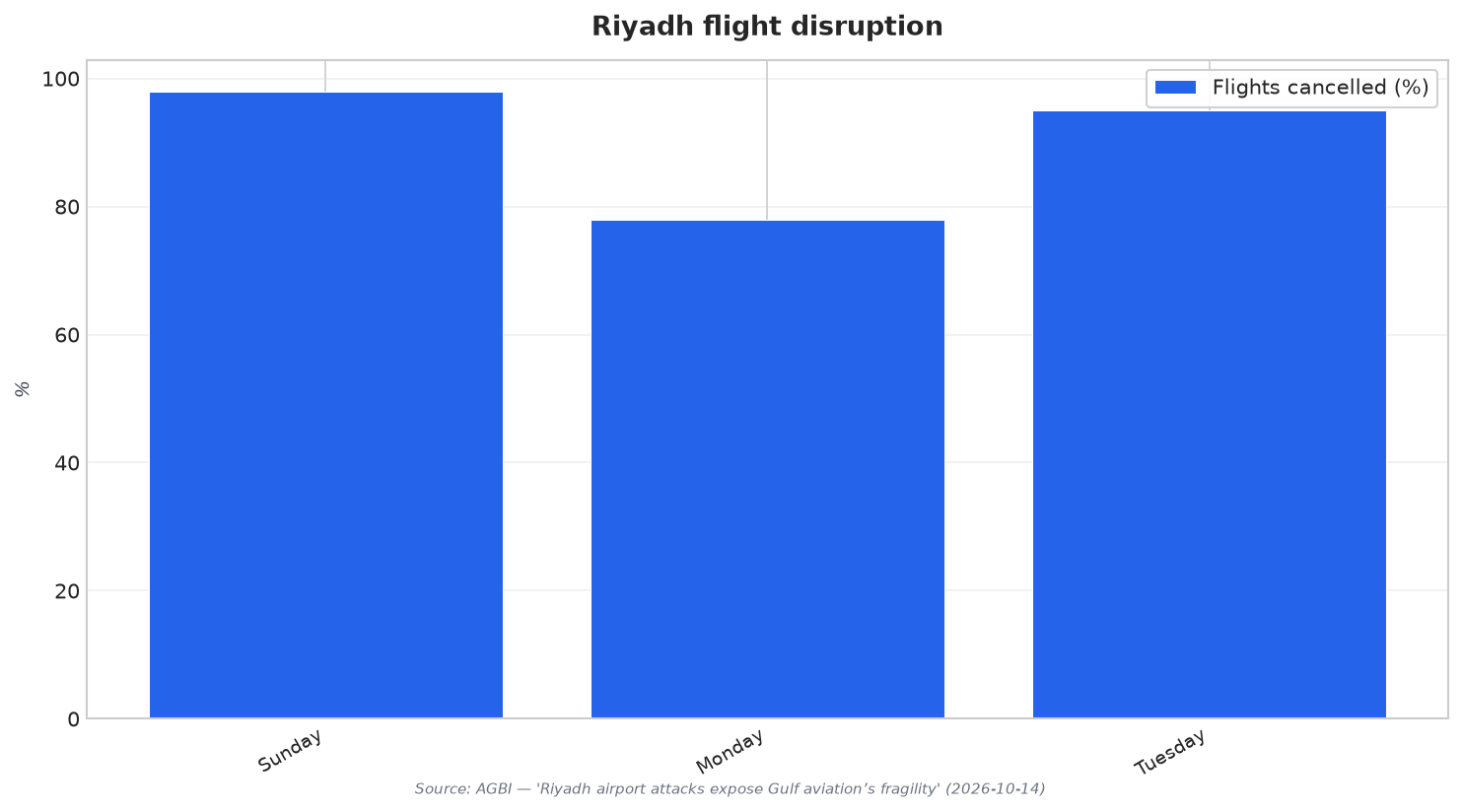
The operational shock was visible in departures and cancellations. One report said that on Tuesday only 16 aircraft took off from Riyadh, compared with a scheduled 333, or around 5% of planned departures. It also said 98% of flights were cancelled on Sunday and 78% on Monday. On an average day, 131,000 scheduled seats are available to and from Riyadh, split evenly between domestic and international services operated by 39 airlines. For airlines, this is a direct revenue problem and an asset-risk problem at the same time. The same report noted 50 aircraft parked at Riyadh that had not moved for four days, highlighting how quickly capacity planning turns into aircraft protection and recovery logistics.
How Risk Premiums Reprice Hubs, Networks, and Connectivity
When uncertainty rises, the cost of operating rises with it. “Hubs are built on predictability, and the moment a capital-city airport is struck, the risk premium goes up for airlines, insurers and transfer passengers,” one aviation analysis quoted. It also reported that almost half the flights scheduled to depart from Saudi Arabia’s airports were cancelled on a Monday, citing Cirium. This repricing hits hub strategies hardest. The same analysis argued that Riyadh Air is particularly exposed because its business model depends on Riyadh becoming a reliable international transfer point, while established carriers such as Saudia and Flynas can draw on domestic and religious travel. In that framing, stability becomes a core “product feature” of the hub itself.
Policy and advisory signals can deter demand even without a national closure. Britain’s travel advice, updated on 15 October, cautioned against all but essential travel to Saudi airports except Medina International Airport, while the United States issued a Level 3 advisory on 12 October. In parallel, the European Union Aviation Safety Agency updated an active conflict zone advisory for the Jeddah flight region at all altitudes, advising airlines to operate with extreme caution and review operations; one report said this was enough to deter all EU airlines operating in the region. In the U.S. context, a CNBC report said the Federal Aviation Administration warned U.S. carriers about safety-of-flight risks when flying in or over Saudi Arabia, as airlines suspended or postponed service to Riyadh after attacks described as the deadliest in the country in more than a decade.
Businesses and airlines are already adapting with workarounds that reshape demand patterns. An AGBI analysis described travellers driving long distances overland from other airports and others working online instead, while noting that no European carrier was currently flying to Riyadh and many regional airlines were keeping their distance. It also reported that some flights operated by Saudi airlines were rerouted through Prince Naif bin Abdulaziz Airport, which handled 1.7 million passengers last year and was described as roughly 4% of the number that passed through Riyadh. These behaviours show how Saudi Arabia aviation security concerns translate into route substitutions, remote-work decisions, and a changed willingness to commit to time-sensitive travel, even when some services tentatively restart.
What happened to departures and cancellations at Riyadh’s airport after the attacks?
How large is Riyadh’s scheduled seat capacity in normal conditions?
Why do attacks change hub economics so quickly?
What official advisories and guidance affected travel and airline decisions?
How are Saudi Arabia aviation security concerns changing business travel patterns to Riyadh?