A wartime survey must do more than ask whether managers feel “better” or “worse.” It should pinpoint where confidence breaks: demand, delivery capacity, pricing power, or cash collection. Saudi Arabia has strong foundations for this. The Riyad Bank Saudi Arabia PMI, compiled by S&P Global since 2009, surveys about 400 purchasing managers across the non-oil private sector and is published on the first business day of each month with no revision. It tracks five components with set weights: new orders (30%), output (25%), employment (20%), supplier delivery times (15%), and stocks of purchases (10%). A question set that mirrors these mechanics, but digs into wartime frictions, can turn sentiment into operational insight.
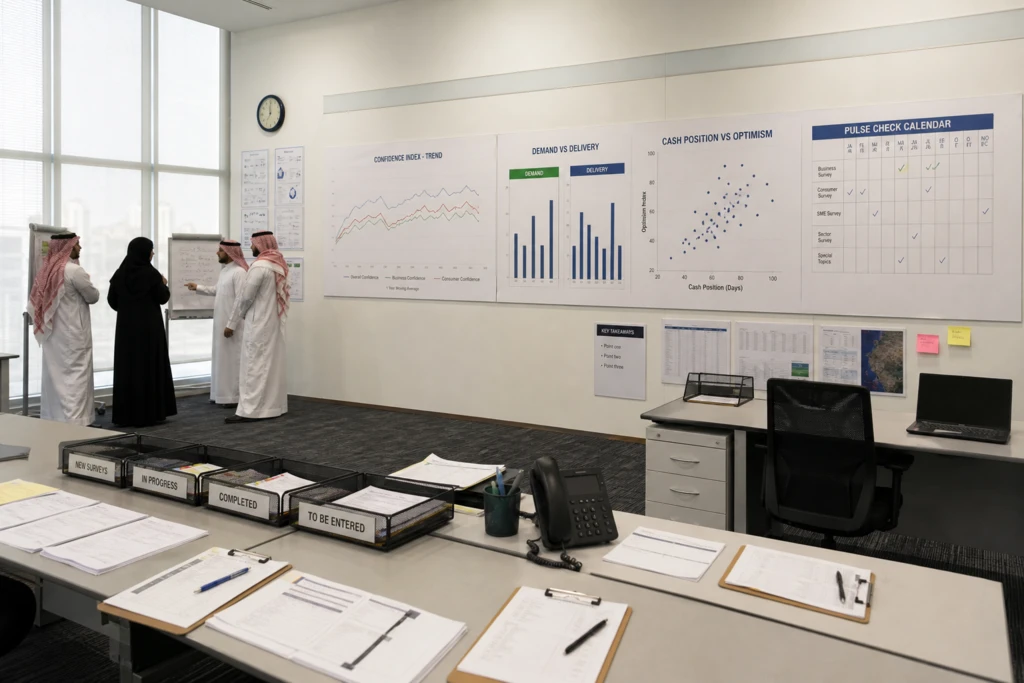
The first module should separate orders from conversion. September 2026 illustrates why: the non-oil PMI rose to 55.3 from 53.8 in August, reaching its highest level since February, supported by stronger new orders, even as the same release described slower output growth and weaker business confidence. Survey wording should therefore ask: are new orders rising, and are they being delivered on time, invoiced, and paid? It should also record whether managers are seeing delays driven by external demand shocks, domestic customer confidence, or specific supply chain disruptions, because wartime conditions can change the “pipeline” without changing the ability to produce.
What Wartime Questions Should Measure Beyond the Headline Index
A second module should force clarity on what a diffusion index can and cannot say. PMI methodology records whether variables increased, were unchanged, or decreased versus the prior month, with “no change” receiving half weight in the diffusion calculation. This makes the index a measure of breadth, not a direct translation into percentage output or GDP growth. Questions should therefore request not only direction, but also the driver: input cost dynamics, selling price decisions, and supplier delivery times. This is crucial when conditions are volatile. In March 2026, reporting cited steep falls in new export orders and weaker domestic customer confidence that dampened sales and led businesses to reduce output, alongside survey-record pessimism regarding the outlook; Saudi Arabia’s PMI was reported at 48.8 in that context.
A third module should capture resilience actions executives are taking. Reuters reporting on wartime Gulf conditions noted that Saudi Arabia had rerouted crude oil and logistics to ports on the Red Sea to bypass the Strait of Hormuz, alongside a wartime initiative to help reroute Gulf cargo via its Red Sea ports. The same reporting said that in May, Saudi Arabia’s non-oil private sector expanded at the fastest pace in three months as domestic demand improved and supply chains stabilized, even as business optimism remained subdued. A good survey asks whether firms are benefiting from rerouting, restarting previously delayed projects, or seeing stronger domestic demand—while also measuring whether optimism remains constrained by uncertainty.
Finally, the survey should connect confidence to sector detail and official statistics. GASTAT’s methodology describes an Overall Business Confidence Index and also publishes confidence for sectors including construction, aligned to ISIC4 activity classifications. It also notes that these indicators are published monthly only and are considered one of the inputs to the outputs of the National Accounts, referencing the United Nations Economic Tendency Surveys handbook (2015). For practitioners, this means the survey should ask executives for activity-level views—hiring intent, project pipeline stability, and supplier reliability—so decision-makers can interpret headline moves alongside monthly confidence and PMI readings, and understand when “subdued optimism” is a demand problem versus a delivery or margin problem.
What should a Saudi business confidence survey prioritize during wartime?
How should executives interpret a PMI reading like 55.3 in Saudi Arabia?
What evidence shows wartime shocks can quickly flip business conditions in Saudi Arabia?
Why include supply chain and rerouting questions in a Saudi executive survey?
How does Saudi Arabia structure official business confidence statistics?