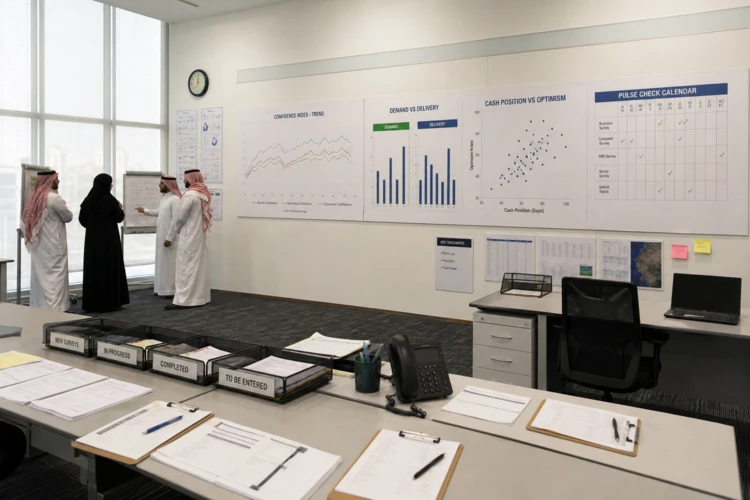
“Enter now or wait?” is usually framed as a market-demand question. In Saudi Arabia, it is also an execution question. A practical framework for foreign companies argues that the primary barrier to successful entry is not strategic misalignment, but operational under-preparedness. That matters for a Saudi Arabia market entry 2027 decision, because the lead time is not only about sales. It includes setup, compliance, people, and the work of building credible local operating routines while regulatory and procurement practices keep evolving.
Start with momentum signals, then pressure-test them against your operating plan. One market entry guide notes that, according to Invest Saudi Arabia, foreign direct investment reached SAR 22.8 billion in Q2 2025. Another analysis cites GASTAT first-quarter 2025 net FDI inflows of SAR 22.2 billion, a 44% year-on-year increase, and says total FDI stock reached USD 293 billion in 2025, nearly double 2017 levels. A separate market assessment source places Saudi Arabia’s GDP at $1.32 trillion and adds an industry projection that GDP growth is expected to accelerate to 4.5% by 2027. These figures can support a “don’t wait forever” conclusion, but only if your operating model can keep up.
A Market Entry Timing Framework: Readiness Before “Rebound”
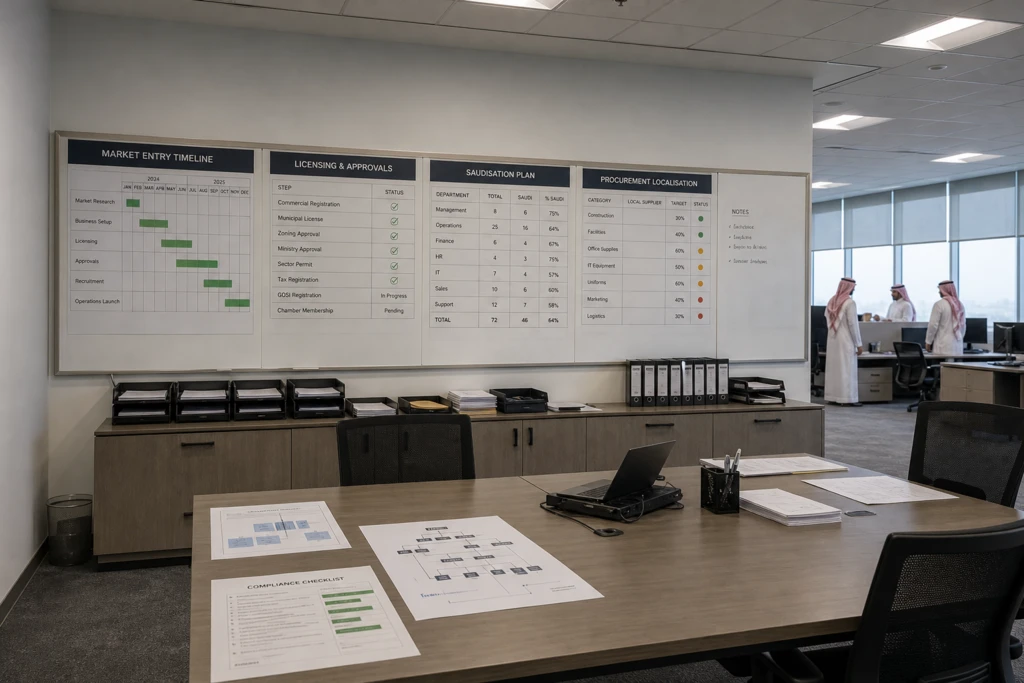
A practical timing framework has three gates: (1) regulatory and setup feasibility, (2) talent and compliance readiness, and (3) customer-access path dependence. On feasibility, one guide describes five phases from research to operational scaling, with 2 to 4 months for setup and 6 to 12 months for staffing. It also notes MISA licence registration in 1 to 2 weeks. On compliance, it states 20% corporate tax for foreign entities, mandatory PDPL data compliance, and sector-specific Saudisation requirements that, in some cases, reach 70–80% for defined roles. If you wait, these are not “later problems”; they become compressed problems with less margin for error.
Next, model how localization and procurement rules could shape timing by sector. One operating-presence analysis reports that the Local Content and Government Procurement Authority introduced minimum local-content requirements for 233 identified products from 1 August 2026 for covered government procurement mechanisms, with additional identified products scheduled for 1 August 2027, including certain split air conditioners, water pumps, water valves, copper wires, and medical devices and supplies. The same source warns against assuming all procurement or private-sector buying follows the same requirement. This is the timing insight: industrial suppliers exposed to government procurement may need localization planning earlier than software or private-sector-led models.
Finally, assess competitive timing risk: projects are often shaped before a tender is public. The operating-presence source notes that by the time an opportunity becomes visible, competitors may already understand requirements, qualification may be underway, and tier-one contractors may have organized supply chains. If your strategy includes an RHQ route, the same source lists requirements: the RHQ must be a separate Saudi legal personality; commence mandatory RHQ activities within six months; commence at least three optional RHQ activities within one year; and employ at least 15 full-time employees within one year, including at least three senior executives at specified senior levels. Vision 2030 progress metrics also signal a shifting window: one analysis states non-oil activities now make up more than half of real GDP, and 93% of Vision 2030 performance indicators have met or exceeded targets, or are rapidly approaching them. The practical takeaway is to enter when your execution plan is ready, not when the market feels “fully settled.”
How should a firm decide whether to enter Saudi Arabia now or closer to 2027?
What timelines should foreign companies plan for Saudi setup and hiring?
Which compliance issues can make a late entry risky?
What procurement and localization shifts matter most for 2026–2027 planning?
What does the article mean by “Saudi Arabia market entry 2027” as a timing topic?