Residential is the biggest slice of Saudi Arabia’s construction activity, which helps explain why it can appear more resilient than other segments when sentiment shifts. IMARC Group positions residential as the largest construction segment, accounting for 42.5% of total market revenue in 2025, and it estimates residential construction investment at approximately USD 43.3 billion in 2023. That leadership matters because housing programs and delivery schedules create a steady baseline of work. IMARC also notes targets that keep the pipeline visible, including a goal to develop 660,000 residential units by 2030 to support long-term urban expansion and a broader homeownership goal of 70% by 2030 tied to the Housing Program.
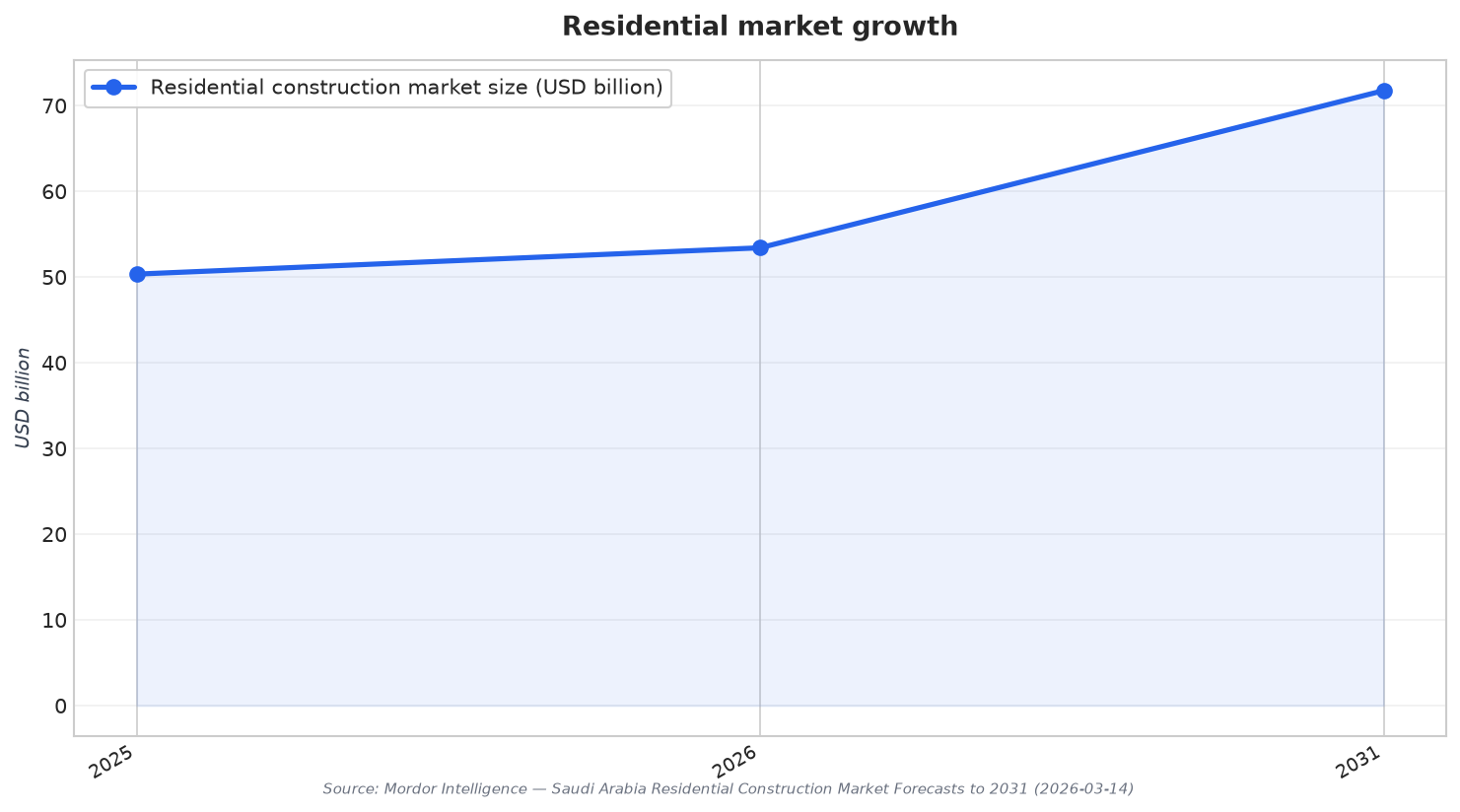
Forecasts from multiple research firms also align with the idea that housing demand stays structurally important. Mordor Intelligence projects the Saudi Arabia residential construction market at USD 50.34 billion in 2025 and USD 53.41 billion in 2026, reaching USD 71.75 billion by 2031, with a CAGR of 6.09% from 2026 to 2031. It also links planning and execution to policy support, stating that government backing through Vision 2030 keeps annual housing demand around 300,000 units. That consistent need shapes what gets built: apartments and condominiums led with 68.7% market share in 2025, and new-build schemes captured 84.5% of the market in the same year.
What Keeps Residential on Top: Targets, Capital, and Execution Capacity
Several concrete delivery mechanisms reinforce the outlook for Saudi Arabia residential construction demand. IMARC points to ROSHN’s ambition to deliver 1.5 million homes by 2030, alongside government mortgage guarantee programs, as support for residential leadership. Mordor adds detail on how funding and capacity are shifting: private capital accounted for 70.1% of 2025 spending, while public-sector programs financed by REDF and PIF are set to rise at a 6.31% CAGR to 2031. It also describes operational pressure, with contractor pipelines “filling quickly” as PIF subsidiaries pre-book capacity, and it notes that streamlined permits on the Etmam digital platform can shorten development cycles and support new launches.
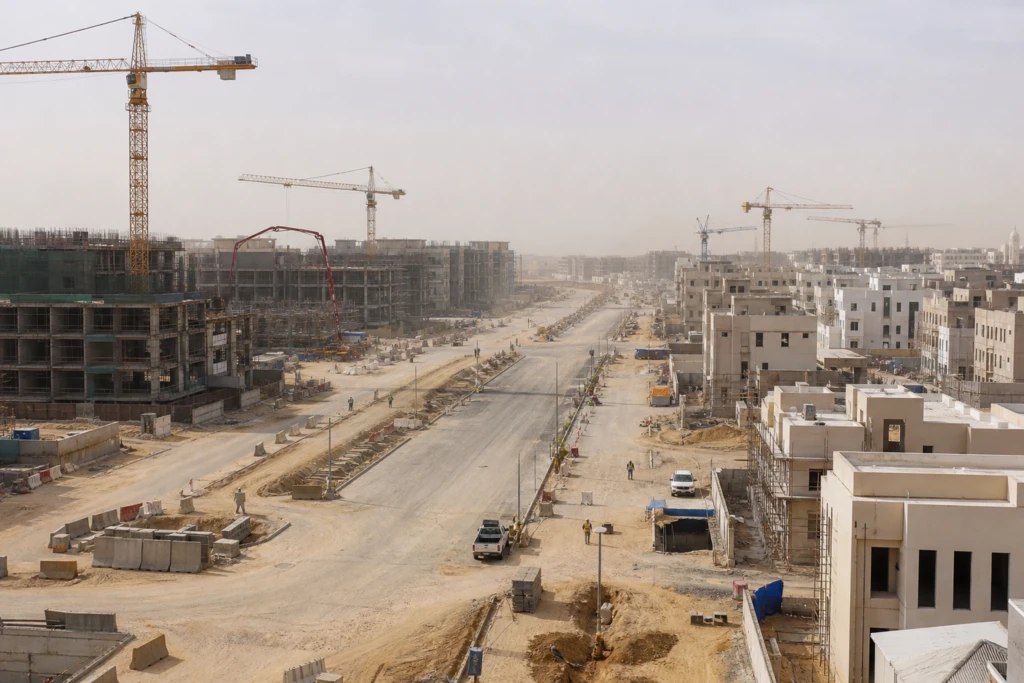
Projects and city-level concentration add another layer of stability because they anchor demand to specific masterplans rather than one-off transactions. Mordor reports Riyadh commanded 41.3% of the Saudi residential construction market size in 2025. It also highlights a single development scale marker: ROSHN’s 20 km² Riyadh community is planned to house more than 30,000 families once complete, and in January 2026 ROSHN let SAR 1.5 billion (USD 400 million) of Phase 4–5 contracts while securing SAR 2.1 billion (USD 560 million) of new land. Separately, the National Housing Company (NHC) oversees 134,000 units across 17 cities under joint-venture terms, indicating a broad multi-city delivery model rather than a single-market bet.
Price and real estate indicators can also reinforce the residential narrative by signaling end-user pull and investor confidence. IMARC’s real estate report cites data from the General Authority for Statistics showing a 1.7% year-on-year rise in Q2 2024 real estate prices, driven by a 2.8% increase in residential property values. On the supply-chain and delivery side, IMARC notes that residential real estate dominates with a 60.5% share, driven by government housing initiatives and subsidized financing support. It also points to cross-border partnerships as a capacity lever: in October 2025, NHC entered agreements and memoranda of understanding with Chinese firms as part of a strategy to develop 100,000 Saudi-Chinese housing units by 2030, including framework agreements for more than 24,000 residential units.
What shows that housing is the leading construction segment in Saudi Arabia?
How large is the residential construction market expected to be later this decade?
What policy targets are linked to Saudi Arabia residential construction demand?
Which city leads residential construction activity, based on the sources?
Are there signs of strengthening residential prices alongside construction activity?