Saudi Arabia has delayed its flagship investor gathering, pushing the 10th edition of the Future Investment Initiative (FII) to Oct. 25 to 28, 2027, according to a statement. The annual event is typically held once a year in October, but the 2026 conference was postponed after continued attacks. Reporting on the decision describes a compressed timeline: organizers signaled a shift toward hybrid or virtual options on Sunday (18), and by Monday (19) around 6:00 p.m. local time they confirmed the in-person edition could not proceed and would move into 2027. In its statement, the organizer said it wanted the milestone edition to deliver the “full scale, quality and impact” that speakers and participants had come to expect.
When a Future Investment Initiative postponed decision lands this late in the calendar, it becomes more than scheduling news. It is a sentiment test. Analysts told AGBI that the absence of the conference could exacerbate a slowdown in deal-making into next year, because the forum has played a major role in bringing international investors to Saudi Arabia since its 2017 launch. Officials have pointed to deal flow as a defining feature, with more than $50 billion of deals and investments announced last year. Bloomberg and other coverage emphasized how much the event relies on high-level networking, and why organizers weighed the risk that a virtual gathering could dilute what had become a showcase for Crown Prince Mohammed bin Salman.
Reading the Signals: Markets, Money Flows, and Deal Risk
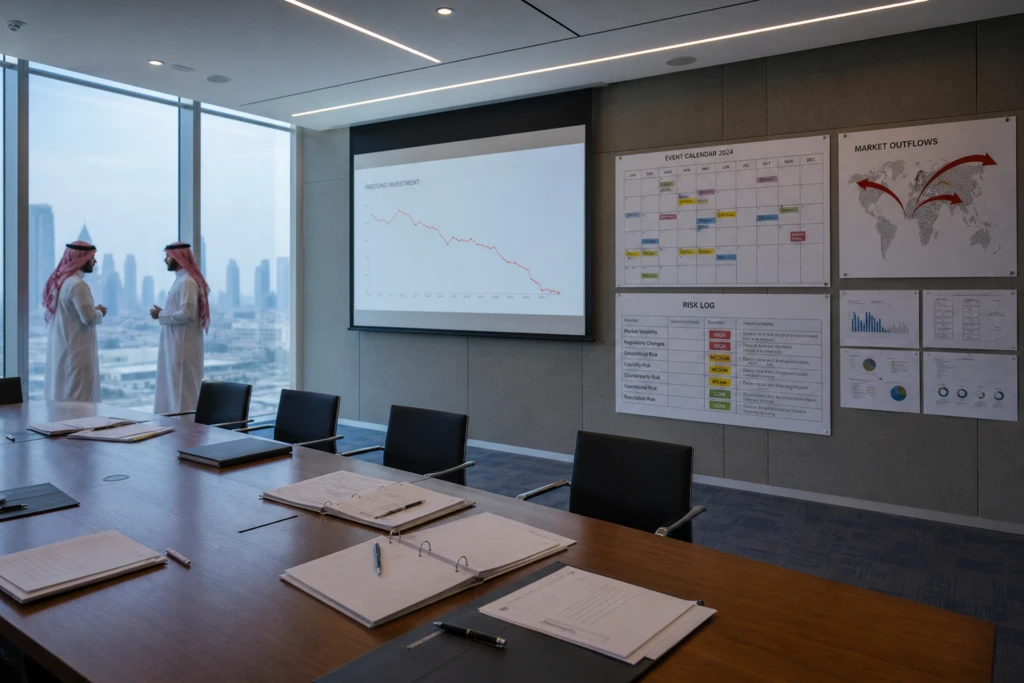
Recent market data cited by AGBI adds context to the mood around the postponement. In the last six weeks, foreign investors sold around $2 billion of Saudi equities. The All-Shares Index, which tracks the main market, fell to a 43-month low on Tuesday. AGBI also reported that foreign direct investment fell by around 20% year on year in the second quarter of 2026, which economists described as within normal fluctuations but still a blow to the kingdom’s efforts to triple FDI by the end of 2030. Robert Mogielnicki of PoliSphere Advisory said persistent Houthi attacks ultimately led to the postponement.
The practical issue for investors is which deals suffer when a major convening moment disappears. One analyst cited by AGBI said deals that are already ready to be announced are among those least likely to be impacted, while deals that have not yet been initiated are considerably more vulnerable. That matters because FII’s value is not only announcements, but also the hallway conversations that set up first meetings and build confidence to start. Several top executives were expected for the 2026 edition, including Jane Fraser of Citigroup, David Solomon of Goldman Sachs, and Larry Fink of BlackRock. Coverage also noted that even the opening panels last year brought together leaders of companies with a combined market value of almost $3 trillion.
Security and travel disruption sat in the background as the decision was made. Coverage described air-raid sirens sounding in Riyadh as the postponement surfaced, while King Khalid International Airport restricted flights for an indefinite period. Other events also shifted: the EU-GCC summit scheduled for Oct. 24 was postponed on Oct. 15 with no new date announced, and Intersec Saudi Arabia moved to October 2027. Bloomberg reported that the Capital Markets Forum Select in London, organized by the Saudi and London stock exchanges, was also postponed amid air travel restrictions. Taken together, the 2027 reset is not just about a conference date, but about whether Saudi Arabia can recreate the scale and certainty that made FII a central stop for global capital.
When is the Future Investment Initiative now scheduled to take place?
Why was Saudi Arabia’s flagship FII forum postponed into 2027?
What market moves were cited around the postponement?
How does the Future Investment Initiative postponement affect deal-making risk?